Previous Research
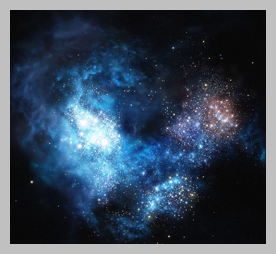
I completed my Ph.D. in 2011 at the Institute for Astronomy in Edinburgh (funded by a FCT Ph.D. Fellowship), working with Philip Best (also with Ian Smail et al.). I was (and still am) heavily involved with the High-Redshift(z) Emission Line Survey (HiZELS), a panoramic extragalactic survey using WFCAM/UKIRT with which we are finding thousands of very distant emission-line galaxies. The majority of such galaxies are detected because of their strong Hα emission, mostly coming from hydrogen atoms which got ionised (and recombined) by the intense UV radiation of massive newly-born (very blue) stars when the Universe was only 6, 4 and 3 billion years old. By obtaining large and clean samples of such distant galaxies, right at the peak activity of the Universe (when most present-day stars where formed), we are providing a much more detailed and clearer view on how and by which physical mechanisms galaxies form, evolved, and ended up the way we see them today. So far, I have been doing that by investigating (mostly for the first time) the nature, clustering, evolution, morphologies, environment and mass-dependences of such distant Hα emitters at high-z (z=0.84 and z=1.47, when the Universe was 6 and 4 billion years, respectively), but I have also been searching for even more distant galaxies (at z=9, when the Universe was only 0.5 billion years old). You can find a list of my latest publications here.
About me and some of my research:
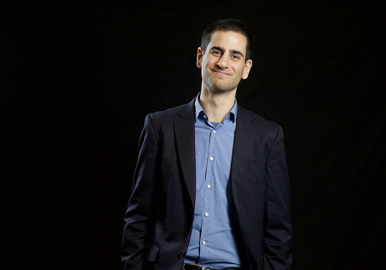
name David Ricardo Serrano Gonçalves Sobral
location Lancaster, UK
POSITION Lecturer in Astrophysics
AREA Extragalactic Astrophysics
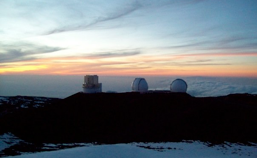

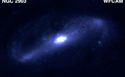
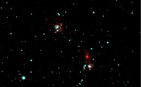
HiZELS is a panoramic extragalactic survey using the WFCAM instrument on the 3.8-m UK Infrared Telescope (UKIRT). The survey uses a set of existing and custom-made narrow-band filters in the J , H and K bands to detect emission line galaxies up to z=9 over square degree areas of extragalactic sky. Important results on the nature, clustering and evolution of star-forming galaxies.
Some Highlights from my research
Key questions:
-
1)How much star-formation is on-going at each epoch and how does that evolve using one single well-calibrated star-formation indicator?
-
2)What is the nature (quiescent/merger driven) of the star-forming galaxies and what can that imply? What are their morphologies and how are those connected to the nature of such galaxies?
-
3)What are the clustering and environment properties of star-forming galaxies? How much influence does the environment has on the evolution of such star-forming galaxies and how do they evolve into the local galaxies seen today?
-
4)How common are bright galaxies at z=9 and how much can we learn from them?
The strong evolution of the Hα LF and the star-formation history of the Universe:
-
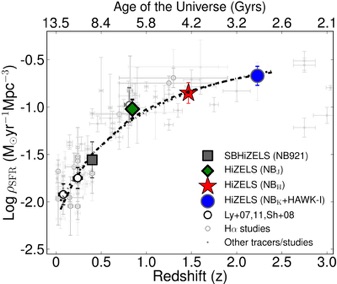
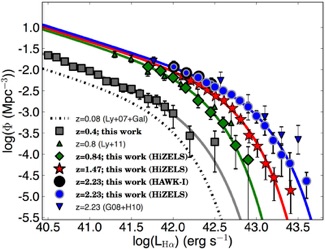
1)There is a clear evolution in the Hα luminosity function. Bright emitters increase rapidly with look-back cosmic time up to z=2.5, while the over-all number density rises up to redshift unity and then decreases.
-
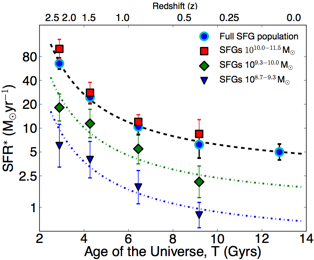
2)There is a steady rise in the star-formation activity of the Universe up to redshift unity, when the Universe was about half its age. This is followed by a flattening and constitutes a robust result using one single star-formation indicator and narrow-band selection of emitters from z=0 up to z=2.23.
Deep imaging reveals the dominance of disks and morphology-Hα relations at z∼1
-
1)Mergers only account for 20% of the total star-formation rate density of the Universe when the Universe was about 6 billion years old and that fraction is reduced for later and later times up to the local Universe.
-
2)The decline in the star-formation activity of the Universe is due to the evolution of disks, which are 80% of the star-forming galaxies at z=0.845 and continue to be dominant down to the local Universe.
-
3)At higher redshift, however, merger-driven star-formation activity becomes more important, resulting in a clear evolution of the bright end of the luminosity function.
-
4)While disks are dominant for the entire samples, at high redshift their relative abundance decreases and the most active galaxies are Irregulars/Mergers, with this constituting a clear morphology-H-alpha luminosity relation at z=0.84, which is also tentatively found at z=0.24.
Star forming galaxies at z∼1 are mostly disks and it’s their evolution that causes the clear decrease in the star-formation of the Universe as a whole. Mergers only account for 20% of the star-formation when the Universe was 6 billion years old, but become more and more relevant in the early “ages”, significantly contributing for the strong evolution of the Hα luminosity function.
The search for the most distant sources: Bright Lyα emitters at z=9
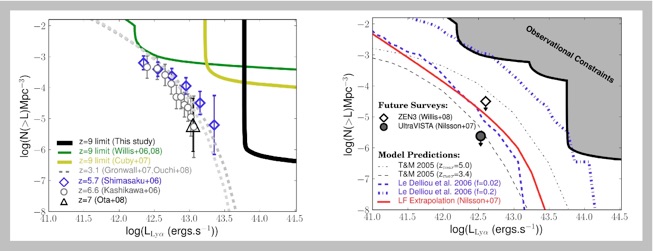
After conducting the largest area survey for Lyα emitters at z=9, using the Wide Field CAMera on the United Kingdom Infrared Telescope and a custom narrow-band filter in the J band, we reached a Lyα luminosity limit of ~10^43.8 erg/s over a co-moving volume of 1.12x10^6 Mpc^3 at z=8.96+-0.06. Only 2 candidates were found out of 1517 line emitters and those were rejected as LAEs after follow-up observations. The limit on the space density of bright LAEs is improved by 3 orders of magnitude, consistent with suppression of the bright end of the Lyα luminosity function beyond z~6. Combined with upper limits from smaller but deeper surveys, this rules out some of the most extreme models for high-redshift LAEs. The potential contamination of future narrow-band Lyα surveys at z>7 by Galactic brown dwarf stars is also examined, leading to the conclusion that such contamination may well be significant for searches at 7.7<z<8.0, 9.1<z<9.5 and 11.7 < z < 12.2.

David R. S. G. Sobral
Lecturer in Astrophysics (Assistant Professor in Astrophysics)
Observational Astrophysics
Physics Department
Lancaster University
Bailrigg, Lancaster, LA1 4YW
E-mail: d.sobral@lancaster.ac.uk